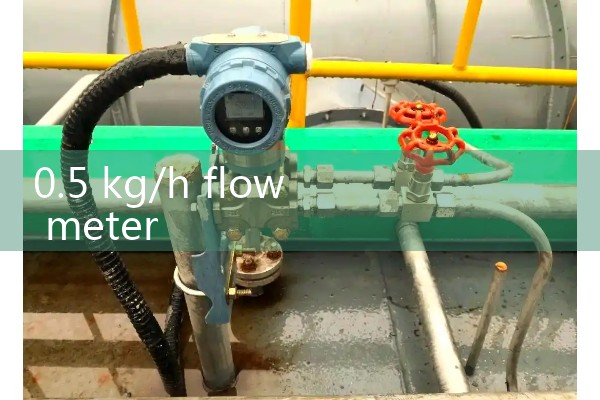
『0.5 kg/h flow meter』Related information(v cone flow meter|rotary gas meter|gallon meter|gear meter|metal tube rotameter|glass tube rotameter|nutating disk meter|transit time ultrasonic flow meter|wedge flow meter|pd meters|hydraulic flow meter|ultrasonic water flow meter|water flow meter|air flow meter|magnetic water flow meter|oxygen flow meter|gas flow meter|argon flow meter|air velocity meter|gasoline flow meter|fuel flow meter|ultrasonic water meter|digital water meter|nitrogen flow meter|solid flow meter|Oxygen tank flow meter|digital water flow meter|diesel fuel flow meter|steam flow meter|02 flow meter|compressed air flow meter|oil flow meter|liquid flow meter)
Of course. Here is an article about a 0.5 kg/h flow meter, written in English, approximately 700 words long.
---
### The Precision of the Small: Understanding the 0.5 kg/h Flow Meter
In the vast world of industrial instrumentation, flow meters are often associated with massive pipelines carrying thousands of liters of water, crude oil, or chemicals per hour. However, the real magic of process control often lies in the precise management of minute quantities. It is here, in the realm of micro-flow, that the **0.5 kg/h flow meter** proves its value. This device, designed to measure a flow rate equivalent to roughly half a liter of water per hour, is not a simple commodity; it is a high-precision instrument critical for niche applications where accuracy at extremely low flow rates is non-negotiable.
To understand the significance of a 0.5 kg/h rating, consider the physical reality. This is a flow rate of approximately 500 grams per hour, or about 8.3 grams per minute. A single drop of water weighs roughly 0.05 grams. This meter is designed to count the equivalent of 166 drops of water *every minute*. The engineering challenge is immense: at such low velocities, the flow can be laminar, viscous, and easily disturbed by even the slightest friction or pressure fluctuation. Traditional impeller or turbine meters, which rely on the kinetic energy of the fluid to spin a rotor, are often useless at this scale, as their mechanical resistance would stop the rotor entirely.
#### Core Technologies for Micro-Flow
To overcome these challenges, the 0.5 kg/h flow meter typically relies on one of several advanced measurement principles.
The first and most common is the **thermal mass flow** principle. This technology is elegantly si
mple. It introduces a small, heated element into the flow stream and measures the rate at which the flowing fluid carries heat away from it. The faster the flow, the more heat is dissipated, and this temperature difference is directly proportional to the mass flow rate. This method is perfect for low-flow gas and liquid applications because it has no moving parts, introduces minimal pressure drop, and can measure accurately down to micrograms per minute. A 0.5 kg/h thermal meter is a common sight in laboratories and fuel cell testing.
The second technology is **Coriolis mass flow**. While often associated with larger pipes, micro-Coriolis meters are the gold standard for high-precision liquid measurement at this scale. They work by vibrating a small U-shaped or straight tube. As fluid flows through the vibrating tube, it causes a phase shift (the Coriolis effect) which is directly proportional to the mass flow rate. These meters are incredibly accurate (often to 0.1% of reading) and independent of fluid density, viscosity, or temperature. A 0.5 kg/h Coriolis meter is a marvel of miniaturized engineering, often resembling a small block of stainless steel with precision-coiled tubes inside.
#### Applications Where Every Milligram Matters
The choice of a 0.5 kg/h flow meter is rarely accidental. It is demanded by applications where precision is not a luxury but a requirement.
1. **Pharmaceutical Formulation:** In the production of IV fluids, vaccines, and injectable solutions, active pharmaceutical ingredients (APIs) are often dosed in extremely small quantities. A flow meter might be used to precisely meter a catalyst or a flavoring agent into a batch reactor. A deviation of even 0.1 kg/h could ruin a batch worth tens



 Of course. Here is an article about a 0.5 kg/h flow meter, written in English, approximately 700 words long.
---
### The Precision of the Small: Understanding the 0.5 kg/h Flow Meter
In the vast world of industrial instrumentation, flow meters are often associated with massive pipelines carrying thousands of liters of water, crude oil, or chemicals per hour. However, the real magic of process control often lies in the precise management of minute quantities. It is here, in the realm of micro-flow, that the **0.5 kg/h flow meter** proves its value. This device, designed to measure a flow rate equivalent to roughly half a liter of water per hour, is not a simple commodity; it is a high-precision instrument critical for niche applications where accuracy at extremely low flow rates is non-negotiable.
To understand the significance of a 0.5 kg/h rating, consider the physical reality. This is a flow rate of approximately 500 grams per hour, or about 8.3 grams per minute. A single drop of water weighs roughly 0.05 grams. This meter is designed to count the equivalent of 166 drops of water *every minute*. The engineering challenge is immense: at such low velocities, the flow can be laminar, viscous, and easily disturbed by even the slightest friction or pressure fluctuation. Traditional impeller or turbine meters, which rely on the kinetic energy of the fluid to spin a rotor, are often useless at this scale, as their mechanical resistance would stop the rotor entirely.
#### Core Technologies for Micro-Flow
To overcome these challenges, the 0.5 kg/h flow meter typically relies on one of several advanced measurement principles.
The first and most common is the **thermal mass flow** principle. This technology is elegantly si
 Hot Blog
 Related AD