

『The working principle of electromagnetic flowmeter』Related information(v cone flow meter|rotary gas meter|gallon meter|gear meter|metal tube rotameter|glass tube rotameter|nutating disk meter|transit time ultrasonic flow meter|wedge flow meter|pd meters|hydraulic flow meter|ultrasonic water flow meter|water flow meter|air flow meter|magnetic water flow meter|oxygen flow meter|gas flow meter|argon flow meter|air velocity meter|gasoline flow meter|fuel flow meter|ultrasonic water meter|digital water meter|nitrogen flow meter|solid flow meter|Oxygen tank flow meter|digital water flow meter|diesel fuel flow meter|steam flow meter|02 flow meter|compressed air flow meter|oil flow meter|liquid flow meter)

1. What is the working principle of an electromagnetic flowmeter? The working principle of an electromagnetic flowmeter is based on Faradays law of electromagnetic induction, which calculates flow velocity and flow rate by measuring the induced electromotive force generated by the motion of a conductive fluid in a magnetic field. 1. Core principle: When a conductive fluid (such as water, acid, alkali, slurry, etc.) flows through a stable magnetic field generated by an excitation coil, the fluid acts as a moving conductor and cuts magnetic induction lines. According to Faradays law of electromagnetic induction, an induced seepage electromotive force (E) will be generated in a direction perpendicular to both the magnetic field and the fluid flow direction. Its size can be represented by the formula E=k B D v, where: • E: induced electromotive force (V) • k: instrument constant • B: magnetic induction intensity (T) • D: inner diameter of the measuring tube (m) • v: average flow velocity of the fluid (m/s) 2. System composition: An electromagnetic flowmeter is mainly composed of the following four parts: • Measuring tube: It is lined with insulating materials (such as polytetrafluoroethylene, rubber) to prevent the induced electromotive force from being short circuited. Excitation system: composed of a pair of excitation coils, used to generate a stable or alternating magnetic field. Electrode: Typically a pair of metal electrodes installed tightly against the inner lining, used to detect the induced electromotive force generated by the fluid. • Converter: The core signal processing unit amplifies, filters, and calculates the weak voltage signal detected by the electrode, and finally converts it into a standard flow sign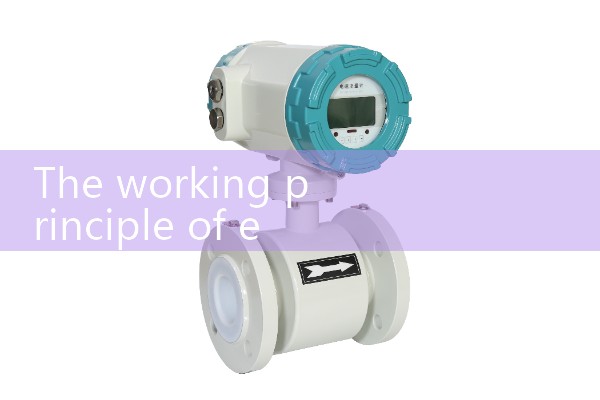
2. Why Q=sv in electromagnetic flowmeter
The reason for Q=sv in electromagnetic flowmeter lies in its working principle and the application of Faradays law of electromagnetic induction.
. 1. Working principle: The electromagnetic flowmeter operates based on the electromagnetic induction law of Faraday. When a conductive fluid passes through an adiabatic imaginary edge conduit equipped with measuring electrodes at a certain flow rate and the conduit is in a uniform magnetic field, the fluid will generate induced electromotive force when cutting the magnetic induction line. This induced electromotive force is related to the flow velocity of the fluid, the strength of the magnetic field, and the diameter of the conduit. 2. Faradays law of electromagnetic induction: According to Faradays law of electromagnetic induction, the induced electromotive force E is equal to the product of the magnetic induction intensity B and the average flow velocity V of the fluid in the conductor, that is, E=B · D · V. 3. The relationship between flow rate and electromotive force: In an electromagnetic flowmeter, the volumetric flow rate Q of the flow rate can be expressed as the product of the flow velocity V and the cross-sectional area S of the pipeline, that is, Q=SV. By combining Faradays law of electromagnetic indu Hot News
 Related AD