

『Flow Meter Installation: Straight Pipe Run Requirements Explained』Related information(v cone flow meter|rotary gas meter|gallon meter|gear meter|metal tube rotameter|glass tube rotameter|nutating disk meter|transit time ultrasonic flow meter|wedge flow meter|pd meters|hydraulic flow meter|ultrasonic water flow meter|water flow meter|air flow meter|magnetic water flow meter|oxygen flow meter|gas flow meter|argon flow meter|air velocity meter|gasoline flow meter|fuel flow meter|ultrasonic water meter|digital water meter|nitrogen flow meter|solid flow meter|Oxygen tank flow meter|digital water flow meter|diesel fuel flow meter|steam flow meter|02 flow meter|compressed air flow meter|oil flow meter|liquid flow meter)

Flow Meter Installation: Straight Pipe Run Requirements Explained
Quick Answer: Most flow meters need a straight pipe section before and after the sensor to stabilize the flow profile. A typical rule is 10 diameters upstream and 5 diameters downstream for a magnetic flow meter, but vortex meters often need 15D up and 5D down. If you compress the straight run, you trade accuracy for space and that trade can cost you 1% to 3% of reading error.
Why Straight Pipe Sections Matter for Your Flow Meter
Fluid moving through a pipe does not travel in a neat straight line. Elbows, valves, tees, and reducers create swirl, asymmetry, and velocity distortions. A flow meter installed too close to these disturbances reads a flow profile that is not fully developed. The result is a repeatable but biased measurement. Engineers at Silver Automation Instruments have seen this on oil separator skids in Malaysia and in chemical dosing lines in Colombia. The fix is almost always the same: give the meter enough straight run to let the profile recover.
In practice, the straight pipe requirement is your cheapest insurance against installation errors. You do not need a longer straight run because the sensor is fragile. You need it because the velocity distribution at the sensing point must represent the whole cross section. Different flow technologies react differently. An electromagnetic flow meter averages velocity across the electrodes, so a swirl that hits one electrode harder than the other creates an offset. A vortex meter counts vortices shed behind a bluff body. Swirl changes the shedding frequency or makes it irregular. A Coriolis meter does not need straight run in theory, but even a Coriolis sensor can suffer from pulsating flow if a pump is too close.
Recommended Straight Pipe Lengths by Meter Type
No single number fits all applications. The table below gives minimum straight runs we use at Silver Instruments when customers send us installation drawings for review. These numbers assume a fully turbulent flow with Reynolds number above 4000. For laminar flow, you may need even longer sections, especially with thermal mass meters.
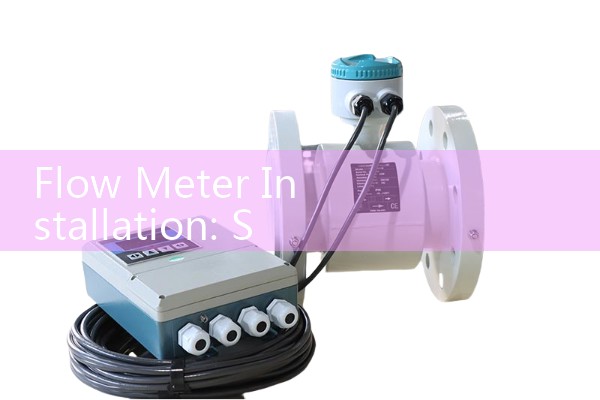
Electromagnetic flow meter: 10D upstream, 5D downstream. If you have a control valve downstream, keep the valve outside the 5D zone. We supply wafer and flanged magmeters from DN6 to DN3000 and we always ask for the pipe layout sketch before shipping. Vortex flow meter: 15D upstream, 5D downstream. A pair of elbows in different planes before the meter will kill accuracy. A flow straightener can reduce the requirement to 10D. Ultrasonic flow meter (inline): 10D up, 5D down for transit time types. Clamp-on meters need 15D up and 10D down because the transducers sample only a chordal path, not the whole cross section. Oval gear flow meter: 5D up, 0D down in most cases, because positive displacement meters are much less sensitive to profile. But you still need a strainer or filter 10D upstream to protect the gears from debris. Thermal mass flow meter: 15D up, 5D down for insertion types. For inline thermal meters, 10D up and 5D down usually works if the gas is clean and dry. Coriolis mass flow meter: 0D up, 0D down for single straight tube designs. Bent tube Coriolis meters may still benefit from 5D upstream if the process has two-phase flow or heavy pulsation. We have seen a beverage plant in Vietnam that added a short 5D spool before a bent tube Coriolis and solved a batching overfill issue.
These numbers are our starting points. Send us your pressure (bar), temperature (°C), pipe size (DN), and flow range and we will confirm the exact straight run for your selected meter. Our email is [email protected], phone +86-135-1213-1526, or reach us on WhatsApp at 86-135-12131526.
What Happens When You Shorten the Straight Run
A paint manufacturer in Indonesia once installed a vortex meter with only 7D upstream because the skid frame was too tight. The meter worked, but it under-read by 2.5% compared to the batch tank load cells. When we helped them diagnose the issue via a video call, we saw a double elbow just 3D ahead of the meter. Adding a tube bundle flow straightener brought the error down to 0.5% without extending the pipe. This kind of field fix costs less than scrapping a skid.
The error you accept depends on your process. Cooling water lines can tolerate 5% error. Custody transfer of crude oil cannot. If you are measuring edible oil to fill 20‑litre cans, a 2% error means 400ml overfill per can. Over a month, that loss adds up. So when a customer in Nigeria asked us for a vegetable oil flo
Flow Straighteners and Where They Help
A flow straightener is not a magic stick. It reduces swirl and breaks large eddies into smaller ones. But it also adds permanent pressure loss. Use a straightener when you cannot physically fit the recommended straight pipe, not as a default choice. Tube bundle straighteners work well for vortex and turbine meters. Perforated plate straighteners reduce the upstream requirement for differential pressure devices like orifice plates. For magnetic flow meters, we rarely recommend a straightener because the meter itself is less sensitive to profile, and the risk of the straightener trapping debris or coating is higher, especially in wastewater.
When you do use a straightener, place it at least 5D upstream of the meter and keep the pipe between the straightener and the meter perfectly smooth, with no gasket protrusion. A 1mm inward gasket lip at a DN50 pipe can disturb the profile far more than you expect. We have seen this on a clean water site in Kenya where the customer fought a 1% zero offset for weeks. The fix was trimming the gasket. Simple but easy to miss.
Installation Pitfalls We Keep Seeing on Customer Sites
Here is the thing. Even when the straight run is correct, other details ruin the measurement. Partially open gate valves upstream create a jet that hits one side of the pipe. That jet does not mix out in 10D. A globe valve installed at 45° can create a single swirl that persists for 30D. In thermal mass meters for compressed air, a wet gas slug from a poorly drained line wipes out the reading and sometimes damages the sensor. Always install a water separator and drain trap before a thermal meter.
Another common mistake is reducing the pipe size right at the meter inlet. A reducer is a flow disturbance. If you must change diameter, place the reducer at least 5D before the straight run begins, not inside it. For example, if you have a DN100 pipe and a DN80 magnetic meter, install a concentric reducer, then 10D of DN100 straight pipe, then the meter. Do not neck down at the flange face.
FAQ
Does a Coriolis flow meter need straight pipe?
Single straight tube Coriolis meters generally do not require straight pipe runs. Bent tube designs may benefit from 5D upstream if the fluid carries gas bubbles or if a piston pump generates strong pulses. When in doubt, tell us your fluid viscosity (cP) and gas void fraction.
Can a flow straightener replace upstream straight pipe entirely?
A flow straightener reduces the required upstream distance but almost never eliminates it. You still need a minimum 5D to 8D between the straightener and the meter, depending on the type. Always leave room for service because a straightener can clog in dirty fluids.
Why does a clamp-on ultrasonic meter need more straight run than an inline meter?
Clamp-on ultrasonic transducers measure velocity along a narrow acoustic path, not the full pipe cross section. Any asymmetry in the flow profile directly impacts the reading. That is why you need 15D upstream for clamp-on compared to 10D for an inline spool piece.
What is the minimum straight run for a DN15 magnetic flow meter?
For a small line like DN15, 10D upstream is only 150mm. In practice, you often get more than that because the pipe spool itself acts as a straight section. Silver Instruments supplies DN15 electromagnetic meters with a built-in grounding ring. Wire the sensor and let the run take care of the rest. Call us at +86-135-1213-1526 if your compact machine leaves less than 100mm.
Do oval gear meters care about straight pipe?
Oval gear and other PD meters are far less sensitive to flow profile, so 5D upstream is generally enough. The bigger concern is protecting the gears from particles. Install a Y-strainer or basket filter upstream and clean it on schedule. Without filtration, debris will lock the gears and stop the measurement.
Get the straight run right and the meter does its job. Get it wrong and no amount of calibration will fix a distorted profile. If you are finalizing a piping layout for an oil skid in the Middle East or a water network in South Africa, send the layout drawing and fluid data to [email protected]. Our team at Silver Automation Instruments will mark up the drawing with recommended straight pipe lengths and meter orientation free of charge. WhatsApp us at 86-135-12131526 or add WeChat: +86 13512131526 for a quick review.
 Hot Product
 Related AD